
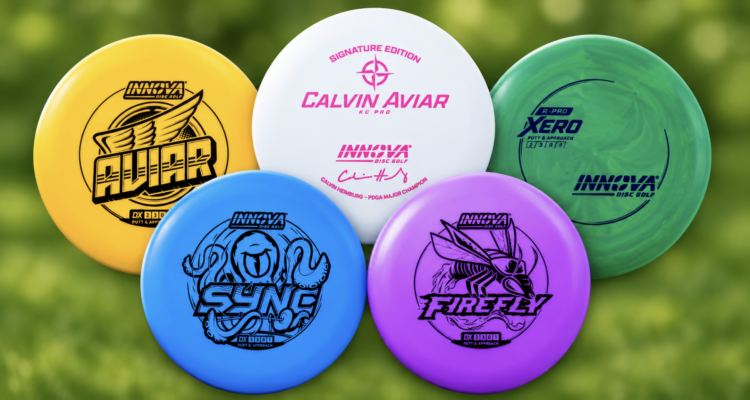
More Makes Await
Unlike with Drivers, where poor disc selection can make certain shots nearly impossible (think of a beginner trying to hyzer flip a Destroyer), the differences between Putters are more subtle, making choosing your go-to disc more difficult. Why pick one over another?
Depending on your putting style, certain combinations of flight characteristics, disc shape, material, and weight will suit you better than others. Finding the right fit can make you more confident and comfortable on the green, and that means more makes.
Flight Characteristics
Speed, stability, and glide all play a role in how a Putter flies. While differences between molds may be subtle on short putts, they become increasingly noticeable as you move farther from the basket.
Speed: Faster Putters can be beneficial on longer putts and get from your hand to the basket more quickly, which is especially useful in a headwind. Slower Putters tend to stay closer to the basket on misses and can enter the chains with more touch, potentially reducing spit-outs.
Stability: Neutral to understable Putters make it easier to maintain a straight flight at putting speeds. More overstable Putters are useful for players who like to putt with anhyzer and can offer added reliability in headwinds.
Glide: High-glide Putters make it easier to reach the basket from longer distances without adding power to your stroke. Low-glide Putters can be advantageous in windy conditions and help limit the length of your comeback putts.
Innova makes several Putters with similar or even identical flight numbers but distinctly different shapes. Once you’ve narrowed down your preferred flight characteristics, choosing between molds often comes down to how the disc feels in your hand.
Disc Shape and Feel
What feels great in one player’s hand might feel awkward in another’s. Here are a few aspects of disc shape that can influence your grip and release.
Beaded vs. Beadless: A bead is a small ridge along the bottom of a disc’s rim. Some players like having a bead to rest their index finger against, giving them a consistent reference point for their grip. Others prefer the uninterrupted, smooth rim of a beadless Putter.
Rim Depth: Some players prefer the fuller feel of a deep-rimmed Putter, while others find a shallow rim easier to grip and release cleanly. Hand size and finger placement can both influence your preference.
Rim Shape: Some Putters have rounded rims, while others have more beveled or flat outer edges. These differences can affect how comfortably your index finger rests against the disc and how cleanly it releases from your hand.
Top Profile: Putters can have flat, domed, or concave tops. The Yeti Pro Aviar, for example, has a slightly concave top, giving it a lower profile than our other Big Bead Aviars. Differences in top profile can affect thumb placement and overall grip.
Thumtrac: Found on molds like the Rhyno, Innova’s Thumtrac® design features a raised ring around the top of the disc, providing an additional point of grip for your thumb.
Choosing Your Material
Finding your preferred mold is only part of the equation. The same Putter in two different materials can feel quite different in your hand.
While premium plastics like Star and Champion are great for Throwing Putters, most players prefer the grip and feel of DX or one of our specialized putting blends on the green.
- DX: Our most affordable material, available in the widest range of molds and weights.
- KC Pro: A stiff putting blend for players who prefer a firm flight plate with minimal flex.
- JK Pro: Developed for five-time World Champion Juliana Korver, JK Pro offers a softer, more flexible feel.
- Yeti Pro: A balance of firmness and tackiness for players who want added grip without too much flexibility.
- Nexus: More durable than DX while still offering the dependable grip players look for in a putting material.
- R-Pro: Our best all-weather grip, with a soft, flexible feel that’s particularly well suited for cold and wet conditions.
- XT: Nearly the durability of our premium plastics, with excellent grip and a firmness between KC Pro and R-Pro.
Some players prefer the clean release of a firmer material, while others favor the feel of a softer blend. It’s about finding what allows you to release the disc consistently.
Keep in mind that temperature affects the flexibility of plastic. Many players gravitate toward softer materials during the winter and firmer materials during the summer.
Choosing Your Weight
Many disc golfers use max-weight Putters, typically 175 grams for most Innova putting molds. Heavier Putters tend to be less affected by wind and can provide predictable distance control.
That said, there are advantages to putting with lighter discs. Lighter Putters require less effort to accelerate, which can help newer players and younger players generate the distance they need on longer putts. The Innova Starter Pack comes with a lighter putter for this reason.
Popular Innova Putters
Here are some of our most popular putting molds, along with what sets them apart.
| Putter | Flight Numbers | Key Characteristics | Suggested Putting Material |
|---|---|---|---|
| Sync | 3 / 3 / 0 / 1 | Low-profile, beadless design, quick release | DX, Proto Glow R-Pro |
| Invader | 3 / 2 / 0 / 1 | Flat top, small bead, controlled glide | DX, Halo Nexus |
| Dart | 3 / 4 / 0 / 0 | High glide, straight flight, beadless design | R-Pro, DX |
| Bullfrog | 3 / 1 / 0 / 1 | Low glide, minimal fade, wind resistance | XT |
| Aviar | 2 / 3 / 0 / 1 | Classic beadless design, straight flight | DX |
| KC Pro Aviar | 2 / 3 / 0 / 2 | Large bead, stiff feel, reliable fade | KC Pro |
| JK Pro Aviar | 2 / 3 / 0 / 2 | Large bead, soft and flexible feel | JK Pro |
| Yeti Pro Aviar | 2 / 3 / 0 / 1 | Large bead, concave top, lower profile | Yeti Pro |
| Firefly | 2 / 3 / 0 / 1 | Deep, beadless profile | DX, Nexus |
| Whale | 2 / 3 / 0 / 1 | Small bead, torque resistance, straight flight | DX, XT, KC Pro |
| Xero | 2 / 3 / 0 / 0 | Small bead, straight flight with minimal fade | DX, XT, R-Pro |
| Nova | 2 / 3 / 0 / 0 | Overmold design, grippy outer rim, straight flight | XT |
| Rhyno | 2 / 1 / 0 / 3 | Thumtrac®, low glide, pronounced fade | DX, R-Pro |
| Animal | 2 / 1 / 0 / 1 | Thumtrac®, low glide, less fade than the Rhyno | KC Pro, XT |
| Birdie | 1 / 2 / 0 / 0 | Thumtrac®, slow, straight flight | DX |
| Sonic | 1 / 2 / -4 / 0 | Catch-disc-inspired profile, understable flight | DX |
Finding Your Go-To Putter
One of the best ways to narrow down your options is to visit your local disc golf shop and get your hands on a variety of molds. Grip each disc as you would when putting. You’ll quickly get a sense of which molds feel best in your hand.
Order a few different Factory Second Putters to see which molds you like best without breaking the bank. When testing Putters, don’t limit yourself to short putts. Try them from the edge of the circle and beyond, where differences in stability and glide become more apparent. You may even find that you prefer one mold for shorter putts and another from long range.
Once you’ve found your go-to Putter, pick up a stack of matching discs and start putting in the reps. Finding the right Putter is an important step toward becoming a better putter, but there’s no substitute for time spent at the practice basket.